Ergo Proxy
a review by OrthrosShrine
a review by OrthrosShrine
When stumbling across most dystopian works (both in literature and audiovisual fiction), you can assume with no hesitation or mislead that the plot will probably reflect a detailed and quite complicating exploration of the presented setting. While not being exactly formulaic, the multiple repetitive attempts on this subgenre of sci-fi range from fantastic experiences to bottom-of-the-barrel kind of pretentiousness. Normally, highly ambitious; yet the fresh air they once possessed has been slowly weakening as time goes on. Fortunately, a particular Manglobe production aired during 2006 came to slap on our faces what an extremely experimental creation can actually achieve. Ergo Proxy is a title that pleasantly defies all conventions stablished for most science-fiction stories found in the medium. Unlike your typical dystopian setting, the human society is not the main focus of the story, nor are the weird mechanisms of politics or the rebellion of manufactured robots. Instead, Ergo Proxy takes us into a journey. A metaphysical, deeply philosophical and enriching adventure that stands out from any other title of the same genre, as well as becoming a wholly memorable experience in the process.
Right off the bat, you notice what kind of anime you're dealing with. The mood is serious and it doesn't change very often. Ergo Proxy is not a light watch, but a rather interpretative and ponderous one. Actions scenes are present but very far in-between. The series is, in a nutshell, a complex story of self-discovery with various allegories and puzzling references to famous philosophical motifs and mythology (I haven't seen this amount of theme tackling since Final Fantasy X!). The meaning of life, the end of a self and the appreciation of the 'being' are some of the themes explored in the series. Besides the core themes that make a poignant resonance with the cast (which I'll discuss later), Ergo Proxy still delivers a great amount of world build up to care about. The AutoReiv's infection, the misery outside the 'domes', the reasons behind the catastrophe, the origin of Proxies. Everything is slowly answered subtly, avoiding the annoying random exposition and hazardous plot-holes. By the time the show reaches its climax, everything feels satisfyingly wrapped up.
The plot may seem linear basing on the first six episodes, but by the midway it will reveal its episodic, road-adventure narrative as our characters travel from one place to another. This is something that usually leads to a turn-off for most viewers expecting a sense of continuity from their stories, but Ergo Proxy gladly subverts it by having numerous compelling dynamics among its characters, multiple events happening at-the-meantime and themes that are looked into without feeling 'pretentious'. Most of the episodes range from very experimental exploration to exploiting the character's identity crisis: but the big picture keeps reflecting a ride that leaves you on the edge of your seat.
Even so, the story is far from perfect. Often contemplative, the metaphysical nature of the show mixed with the overall subtlety and enormous variety when managing very abstract concepts can make the experience a bit too random and even wacky for many. It's also quite experimental with genres (one episode was about a comedy Pop Quiz contest!), so the change of tone can come a bit too abrupt. Furthermore, the overreaching theme exploration, as with any philosophical series, sometimes leads to a torturous preachiness that appear as extended character monologues.
The characters are the strongest part of the show, undoubtedly. Seemingly shallow at first, they develop a lot of dimensions, learn to value themselves and find a reason to exist within a lacking world, emphasizing how relevant the core themes are to practically everything.
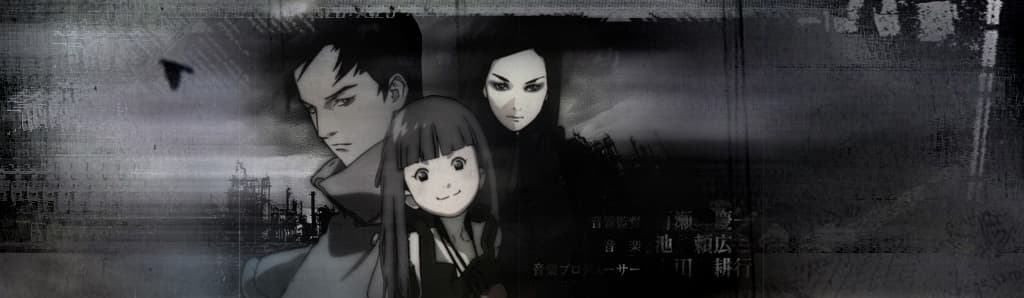
Re-L is the darling of the Romdeau dome Regent, as well as being an arrogant and cold-headed leader-type of character, similar to what Motoko Kusanagi was for 'Ghost in The Shell'. She's also rather tomboy, tricky and over-analytical most of the time, acting heartless towards her personal AutoReiv Iggy. Despite her initial unsympathetic personality, later on the show her attitude touches further layers than what the viewer can think of such a vexatious figure; leaving to us one of the most likable and developed female leads I've seen in anime. Plus, she looks pretty bad-ass when using her trademark automatic shotgun.
Vincent is an immigrant from a foreign dome, aspiring to become a 'fellow citizen' in Romdeau. He's the heart of the series, as the story follows his adventure of self-discovery and search of an identity. He has an innocent, passive attitude towards most people he meets, but also hides a very cryptic side that's getting suffocated by his identity crisis. Curiously, he also has this funny gimmick of keeping his eyes almost always closed.
Pino is the adorable little girl companion-type AutoReiv infected with the Cogito Virus. She's always cheering up mates, repeating gags and buzzwords related to whatever monologue the characters are saying or just joking around. Her presence is crucial so the show never gets too lifeless, and she also develops more feelings as the story goes on. The rest of the cast include Daedelus, doctor and the one in charge of the Proxies investigation, who also shows a naughty obsession with Re-L; and Raw, the chief of the Security Bureau in Romdeau who lost his wife and daughter during the first appearance of the Proxy.
The art is another apartment very well thought-out. Given the very dry and melancholic nature of the show, the color palette is dark and sinister, all the backgrounds are well drawn and the most abstract shots have a striking touch. The animation is quite fluid, too. The character design, though, can turn quite erratic. From different perspectives, the face lines ranges from very plausible to goddamn dreadful. Still, the production values were maintained quite consistently throughout the story, unlike other studios that get really poor and lazy towards the end (*ehem*Gainax*ehem*).
The soundtrack of the series is amazingly atmospheric. While not having a lot of memorable individual tracks, the sound effects are extremely haunting. However, this aspect of the soundtrack pales in comparison to the beautiful opening theme song. "Kiri" (also known as "Come and Save Me~" for the pals) is among the best opening themes I have ever listened to. A very high pitched, surprisingly sung in English and full of feeling, is one of those songs that makes everything a little better. The ending theme song ("Paranoid Android") is also pretty good but lacks the organic and upbeat nature of the OP. If I had to state which dub is superior, I would incline towards the English one. There the voices fit far better and the general seriousness is reflected in a far more plausible way than the seiyuus did. Still, the Japanese is quite decent.
Few science fiction titles had appealed to me as much as Ergo Proxy did. The exploration of its themes is magnific. It has an attractive narrative, great soundtrack and memorable characters. The repetitiveness and some dull moments hinders it from being an absolute favorite, but is still one that I have on my pedestal.
Clearly, it's not an anime for everyone. Very thought-provoking, quite confusing, too subtle for the average viewer; it's an inevitably controversial series. Still, Ergo Proxy remains as a highly recommendable modern classic, and should be watched by anyone who wants something that dares to be different and succeeds splendidly.
35.5 out of 39 users liked this review
