NOTE: This review applies only to the first 2 seasons of Code Geass.
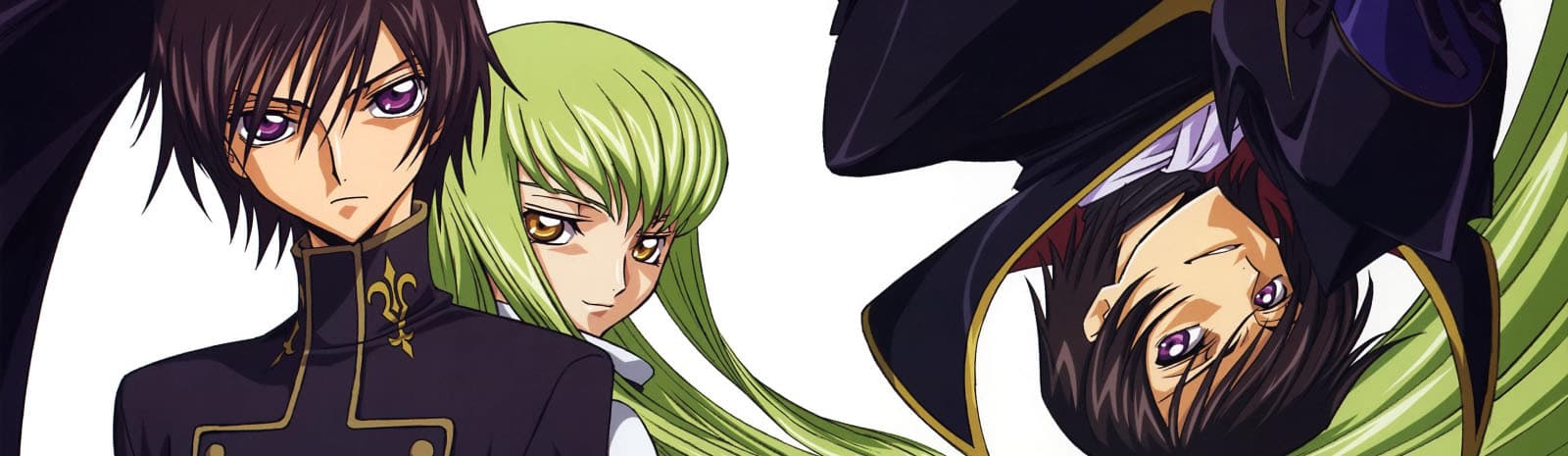
Introduction: Code Geass takes place in an alternate future, wherein Britannia (Great Britain, except Nazis and armed with mecha, basically) has conquered Japan. Lelouch, an exiled Britannian Prince, seeks to topple the Britannian tyranny, avenge his mother and create a kinder world for his blind younger sister, Nunelly. He is aided by a mysterious power called Geass, which allows him to give irresistible orders and bend other people to his will.
The Positive Side: In addition to the intriguing premise, Code Geass has some vivid (if hammy) portrayals of war, racism, drug addiction, colonialism and cultural erasure. One of my favorites aspects of the setting is that under Britannian rule, Japan and the Japanese people have been stripped of their name, and live under the designation, “Area 11.” It’s a brilliant detail that shows the lengths to which Britannia goes to destroy the Japanese sense of cultural and national identity, and one of the reasons the show made a strong and positive impression on me early on.
The Positive Side: Through the first season, Code Geass exhibits strong characterization on all sides of its conflict. Lelouch’s friend Suzaku opposes him throughout the first season, and while we are inclined to root for Lelouch, given the horrific atrocities of the Britanian’s, it easy to understand why Suzaku is on the other side. Suzaku's actions, motivations and reasonings make sense, and even if we do not agree with him, it's hard to blame him or dislike him. Another excellent addition to the supporting cast is Kallen Kozuki, a daring young freedom fighter and half-Japanese Britannian student who joins up with Lelouch’s rebellion on behalf of her down-trodden mother. Kallen is at once a parallel to Lelouch and a foil—while both are motivated, at least in part, by anger at an unjust system that has harmed their mothers, Kallen maintains a moral purity in contrast to Lelouch's more questionable methods.
War is an immense and difficult topic to handle in anime, or any other narrative medium, for that matter, and it’s not always easy to find a Shonen series that doesn’t reduce it to a conflict between obvious heroes and uniformly sadistic and irredeemable villains. Code Geass refuses this simplification, and for that at least, it deserves a little respect.
The Negative Side: Like its protagonist, Code Geass starts off full of promise and blazing ambition, but loses its path, and ultimately, seems to forget what it was trying to achieve in the first place. Code Geass should have been one of the greatest anime ever made, but its faults are so numerous and distracting that it’s often irritating to watch, and ultimately, very hard to take seriously.
Let’s begin with the artwork. While the mecha are well-drawn and have intriguing designs, the artists flounder any time they’re required to draw a person. Nearly every member of the cast is suffering from Terminal Anorexia, Chihuahua Head Syndrome and Early Onset Yaoi Hands. There’s a few martial artists and soldiers in the cast, but the quality of the mecha fights makes every fight not involving a mecha look even more ridiculous. Everyone moves like they’re filled with helium instead of blood. Supposedly human characters leap five times their height, defy gravity and inertia and spontaneously spin into inverted round-kicks with nothing to draw traction from but thin air. If this was explicitly a supernatural martial arts anime like Ranma ½ or Fist of the North Star, I’d have no problem with this kind of silliness, but at its most extreme, Geass is somewhere between Real Robot and low fantasy in terms of its realism, and these kinds of exaggerate maneuvers just feel out of place.
Even more irritating is Geass’s insistence on cramming fan-service into scenes where it has no business being. There’s a moment late in the first season where Kallen and Suzaku become mysteriously stranded on a tropical Island. Kallen, in an absolutely baffling display of misplaced priorities, decides this is the perfect time to take a shower. Suzaku stumbles on Kallen while she’s naked and bathing in a waterfall. Kallen immediately recognizes Suzaku as a Britannian-aligned enemy, draws her knife and charges him. Kallen and Suzaku have both been built as sympathetic and complex characters, and without a moment’s warning, both are thrust into mortal danger. In theory, this should have been a tense, high-stakes scene where two sympathetic characters are at risk of dying. Instead, we get Kallen's teenage tits, followed by her being pinned and mounted by Suzaku. Instead of witnessing two noble characters in a struggle for their beliefs and their survival, we get illogical and tasteless cheesecake.
This is hardly an isolated incident. The fanservice is almost invariably of the creepy variety, either nonconsensual ‘accidents’ or used as a point of shaming the girls. Roughly half the battle-scenes are ruined by pointless, random close-ups of the girls’ breasts and asses.
Perhaps the great harm done by prioritizing trashy fanservice is the degradation of otherwise strong female characters. Kallen, introduced as a fearless revolutionary who has been fighting against Britannia even longer than Lelouch, is forced to wear a playboy bunny suit, to her own shame and humiliation. She is later captured and strapped to a table with what is quite obviously bondage gear, forced to wear a dress that exposes a solid fifty percent of her breasts, and is nearly raped by one of her captors. C.C. spends most of the series as a stoic, mysterious ally with her own agenda and desires, and is one of the only characters in the series who calls out Lelouch on his stupidity and immoral hypocrisy. Following a convenient memory lapse in Season 2, C.C. is reduced to a cringing slave-girl, perpetually terrified of being beaten and eagerly subordinating herself to Lelouch, even stripping at his whim.
This isn't the only point that begins to hint that Code Geass isn't quite as smart as it thinks it is. The series often uses chess in an effort to deepen its motifs of clever planning and mind-games. This would probably be a lot more effective if anyone who worked on the show had ever learned the rules of chess. Every time a characters busts out a chess board, you can count on hilariously stupid and illegal moves. At one point, a character moves his own king into check. Amusingly, his opponent is horrified.
Despite the fact that Code Geass puts focus on tactical intelligence, many of Lelouch’s decisions are mind-blowingly stupid. He walks into obvious traps even he knows they are traps, and is unnecessarily hostile and paranoid towards people who ought to be his allies. Luckily his opponents are often every bit as stupid, as we see in Season 2, when a circle of Britannian nobles dismiss the idea of multiple countries working together in a military campaign as laughable, and claim that the result would be ‘an unruly mob’.
...Hey, Britannians? Remember that whole “World War 2” thing? You know, the one that both Britain and Japan fought in? Turns out countries can actually work together pretty well when they have a common enemy.
Despite the strength of the characters, the dialogue is frequently hammy and ridiculous. Sometimes this is justified by Lelouch’s fondness for theatrics, but sometimes, it’s just plain stupid. There is no context in which the words, “Attention, people of Japan. Could you all just die, please?” will not be ridiculous.
I really wish I could separate seasons 1 and 2, because season 1 is vastly better, but unfortunately, season 1 ends on a massive cliff-hanger that demands I take both seasons as halves of the same story.
Code Geass’s death blow comes near the end of Season 2. I will refrain from giving spoilers here, but will say that the strong characterization given to the main characters is wasted, as they seem to forget their own defining motivations. When characters stop behaving in a way that makes sense for who and what they are, it’s simply not possible to believe in them the way we believe in all the characters we love most dearly. Where there were once compelling and complex characters, there are now puppets, spouting pretentious monologues about vague ideals and coldly marching through whatever actions the writers assign them. No matter how many convoluted schemes or dramatic twists Code Geass hurls at you from that point on, it all ends up feeling hollow and pointless.
Final Verdict: Code Geass is riddled with obnoxious faults in taste and style, but beneath these faults, there’s artistic ambition, moral insight and a cast of memorable and exciting characters. It’s truly a pity this show was less than it could have been. If you’re curious as to why this anime is so highly rated, feel free to check it out. Otherwise… I, SOLEIL VI BRITANNIA, COMMAND YOU… to go watch something better.
145 out of 229 users liked this review
