
Contains spoilers for "FLCL"
____
#The FLCL Flavor
On the surface FLCL seems like it’s about a lot of things: fighting mechas, evil organizations, aliens and space pirates – but it’s never really about any of those. Despite introducing a lot of concepts and elements that might make it seem like it could be just another action mecha anime in these 6 episodes, this gets quickly thrown out the window while watching as it very rarely if ever expands on them, like Medical Mechanica, Atomsk, the space police or many more, because that’s not what the story is trying to portray to the viewers. FLCL at its core is a tale about a young boy that’s become confused in the path of puberty as he learns about maturity and the responsibilities that come with it. Directed and created by Hideaki Anno’s protégé, Kazuya Tsurumaki.

He followed in his senior’s footsteps as he planned FLCL to break the mold of contemporary television series and be a stylistic experiment that challenged the norms in just 6 episodes that are akin to music videos coupled with the amazing soundtrack brought by the Pillows, which I’ll get deeper into later. Despite its immense absurdity – packed dense with character, variedly stylized, fast-paced and chaotic, it never feels like that’s the only thing that it’s trying to achieve, as it’s all brought together by a narrative that explores the confused mind of a young teen going through puberty and emerging sexual desires and frustrations. It doesn’t just contain sex, violence and absurdity – it uses it as a means to enhance the themes of the show and shape it. And we’re viewing it all through the perspective of Naota on his journey to adulthood, each character he interacts with and episode representing the problems he has to come to terms with to mature. He’s a kid that despite not understanding maturity, he tries to fake it with his own vision of it – uncaring and cool, something a lot of us thought “being grown-up” meant as kids and teens. His hesitation to express himself, deal with his problems and change is what’s holding him back and this is represented by the flavors he’s not fond of, which throughout the duration of the series get painted in an “adult” light. Naota’d much rather stick with the familiarity of childhood – sweetness, than move on to sour or spicy.

All of this constructs the chaotic and sweet taste of FLCL to the viewers that manages to remind us of both our childhoods and our inevitable growth out of it.
____
#The Characters
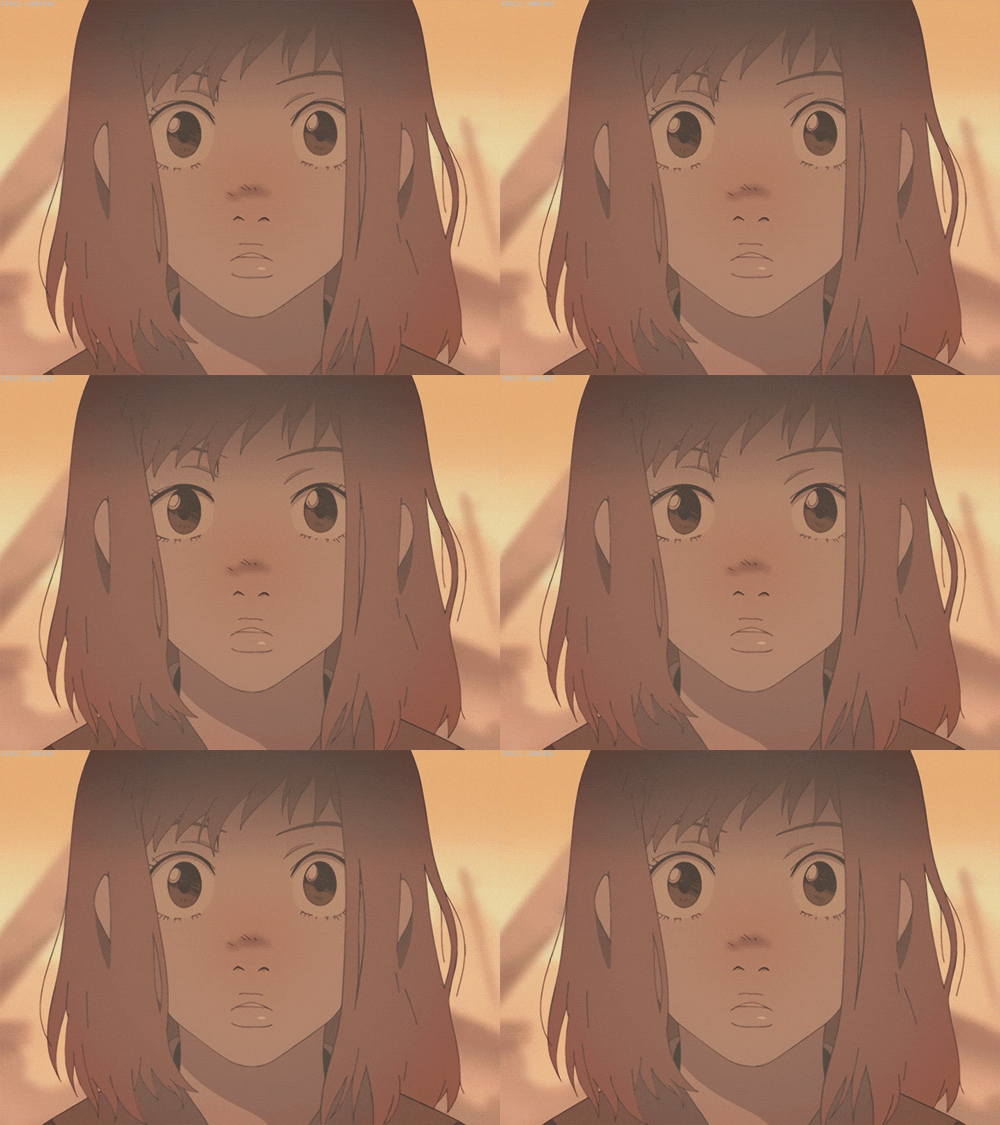
Mamimi Samejima – Every character in FLCL is deeply flawed and troubled, but none quite like Mamimi is. Her pitiable and flawed character is what makes her so relatable to so many and a fan favorite character. Everyone has their own baggage and problems to carry, but it’s more about how you deal with those, in which case Mamimi chooses not to. She spends the entire duration of the anime up until the very end drowning in self-pity and obsessions, accentuated by the iconic ‘never knows best’ cigarettes she always smokes. Mamimi has clear dependency and abandonment issues, because of the fact that she feels left behind and betrayed by Naota’s older brother, who gets painted in a light of greatness. She met Tasuku when he supposedly saved her from the fire that she started to burn down her old school, so when a broken young girl that appears to be poor, bullied, homeless and with an unstable family life gets saved by an almost mythical brother, she becomes emotionally dependant on him and then have this attachment be taken away without her say doesn’t do well for her emotional and mental health. Throughout the anime it’s not even clear whether they really even had any kind of relationship or if it’s just Mamimi’s delusions and fantasies. This obsession with Tasuku, or Takkun as Samejima nicknames him, then causes her to latch on to anything she can get a grasp on and try to have a control over them. She gives the nickname ‘Takkun’ to Naota, alongside others, to try and keep the memory alive as well as to take out her abandonment frustrations and control those that she considers smaller than her. This need for control derives from her feeling a lack of authority with Tasuku, who left her behind as he went to America. Her clinginess to Naota’s brother and anything that could possibly replace him shows her psychological and emotional trauma that her character is based on. Despite being such a deeply troubled character, on the surface very childish and in general a really fucked up person she holds a lot of relatability to many viewers, as mentioned at the start, because of the fact that she is so vulnerable, dependant and prone to making mistakes much like many of us when we were at our lowest. Mamimi’s arc is that of a broken teenager lost in her own head, that after continuously failing to capture the same attachment realizes that there is a big world beyond the mist of the ordinary town Mabase, which makes her decide to pursue photography, and much like Tasuku, she moves out of town.
Haruhara Haruko – The infamous Vespa riding, chaotic-neutral main face of FLCL, Haruhara Haruko, is the physical manifestation of Naota’s confusion and sexual frustrations. Haruko comes barging in on the kid’s daily, ordinary life in Mabase and adds craziness to it, forcing Naota to face the changes both in himself and in the world around him. Haruko manages to give Naota the surface level of his needs, such as adventures in which he can feel like a hero and live up to his idolized brother, or feed Naota’s growing need for physical affection as he transitions into adulthood. He sees Haruko as a chance to prove himself that he’s mature and dependable. Haruhara is in many cases the antithesis to Mamimi, whereas one tries to comfort herself with just a replacement, the other one appears to need Naota for who he really is and appreciate him for that, but in the end it’s revealed that Haruko only ever needed Atomsk and she just saw the potential in Naota to be the key to get to him, because as she said so herself “ you're still a kid, Ta-kun.” In fact I’d argue that the Vespa riding woman never even really loved Atomsk in the traditional sense, only lusting after his great power which she wanted to consume. She only ever superficially fueled the boy’s needs and ego, pulling him in by adding color to the gray life that he was so tired of, while actually only acting out of self-interest and using him as a tool to get to the person she really “loves,” after which Naota realizes that he truly is just a child and has a long way yet to mature in this vast world that expands beyond the fog before him as Haruko leaves him behind and continues her adventures throughout the universe. Much like puberty, Haruko comes in uninvited, makes life crazier and then leaves just like it came, but by the end of it we’ve learnt through the mistakes and broadened our views.

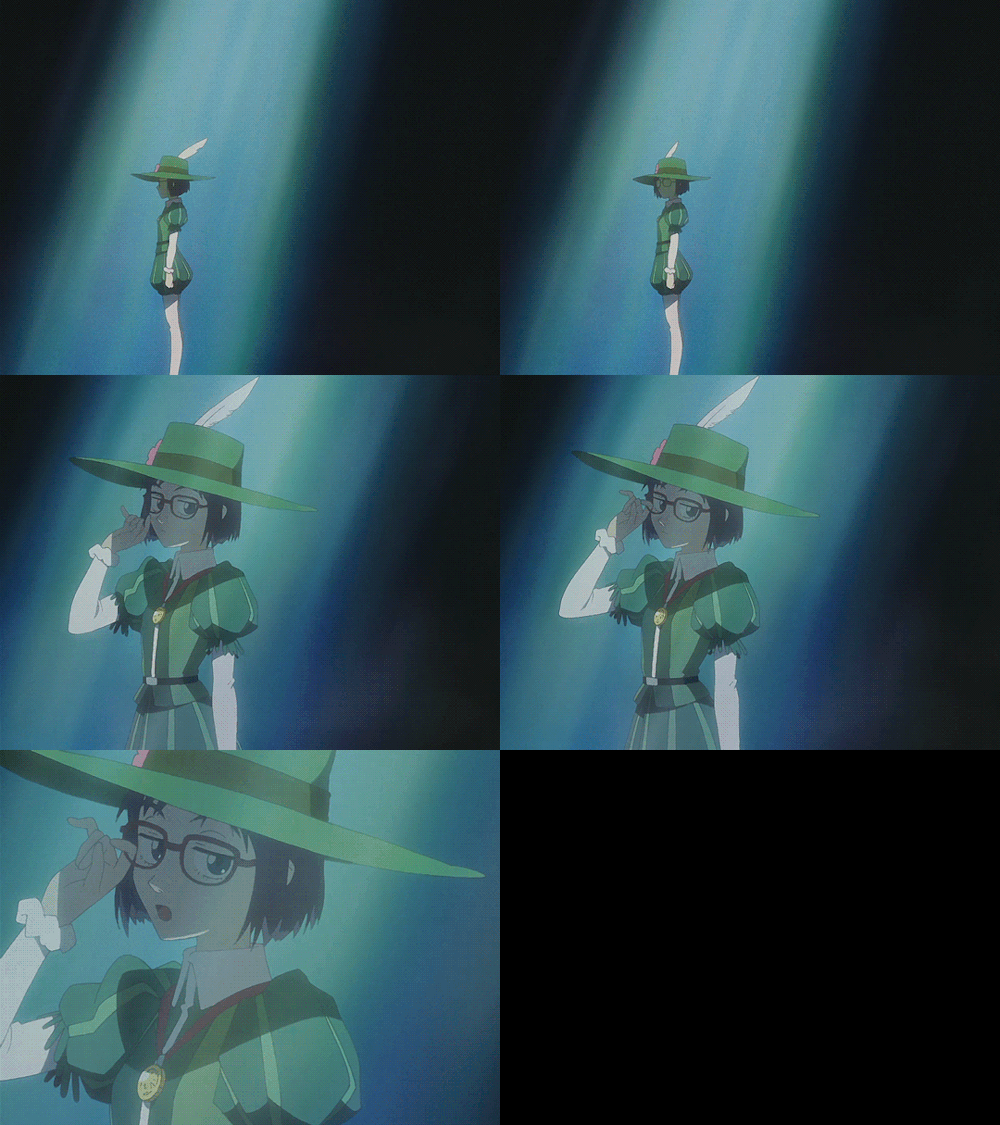
Eri Ninamori – Whilst Mamimi and Haruko act as antitheses to one another and in relation to our protagonist a lot of the time, Ninamori acts as a direct counterpart to Naota himself – similar in many cases, but with slight differences that change everything. Much like Naota she hates admitting her own immaturity and has a skewed view on what being mature really is, and mistakes it for stoicism and apparent invulnerability, for which she gets praised for by others as mature, only proving her right. She hides her true emotions behind a mask of coolness, and in her own words, until the lies become the truth. “You’re Puss in Boots, the one who tricks the prince. He hides who he really is and pretends to be someone else forever. So in time he becomes that person, so his lie becomes the truth, see? He transcends the mask. Don’t you get it? That’s how he finds happiness. That’s pretty good, right?” But despite both her and Naota having a similar view on what being adult really is, they don’t share the same sentiment here, as he doesn’t agree with Ninamori rigging the votes or her entire philosophy in general. Eri wants to get close to others without leaving her true self vulnerable, this in turn making it very hard for her to form real connections to people, as most others only see her for the fake chill façade she puts on and keeping everything locked inside her. The only times we see her actually open up and act more childlike is when she’s with Naota, probably because she sees part of herself in him and feels like this might be her chance to actually form true bonds with somebody. But even then, she was met with confusion and disagreement from Naota, once again proving that people aren’t as understanding or thoughtful as we all want them to be. This need to put a mask on and act like she doesn’t need anybody else other than herself is a result of the pressure put on her by being the class president, the daughter of the mayor that’s having an affair and the perfect image she created in other people’s heads of herself – it all feels like everyone’s eyes are on you and you might crack at any moment. Ninamori’s arc is realizing that by putting on a fake act and hoping it’ll become true won’t make you happy, and, like Naota, accepting her own immaturity. This is shown at the end of episode 3 when she wears fake glasses, not the real ones she wore and showed to Naota in his room. This gesture indicates that she’s now willing to open up and show her secrets to others like she did to Naota, but isn’t obligated to – showcasing her new maturity and control over her emotions.

This truly shows just how much of a breakthrough FLCL was in anime at the time, never afraid to push the boundaries of art, animation and even story telling. But all of this is neatly packaged with my favorite part about the show – the soundtrack. The Pillows manage to really bring out the “music video” or “commercial” feel of the show that Tsurumaki was aiming for perfectly with heavy, hard-hitting tracks like ‘Advice’ for the action packed scenes that manage to feel just as crazy as the fights themselves; melancholic and highly atmospheric songs like ‘Bran-New Lovesong’ that match the nostalgic, summer-like feel of Mabase and just straight-up banger themes like the ending theme song ‘Ride On Shooting Star’ and ‘Little Busters’.

All of these aspects come together to create the chaotic and absurd, yet still tightly knit narrative unique experience that is FLCL.
____
#What is FLCL?
After everything that’s been said – the analyses, the style, the music – what does it all come to? Yes, FLCL is a story about a young boy going through puberty and coming to terms with his innate immaturity whilst also learning what true maturity means, but is it anything more than that? Now I'm going to tell you to throw everything you just read out the window – it doesn't fucking matter. I can sit here and analyze the characters and the show’s themes all I want, but in the end FLCL is what you make it out to be. At the end of the day we don’t know what exactly went through the creators’ heads when they made this OVA, but even more important than what they put into the show is what you got out of it, which is what makes it so special. FLCL came out at the start of a new decade and the new century – almost as if to signify the end of an era, one that birthed experimental and obscure shows like Neon Genesis Evangelion, The Ghost in the Shell, Serial Experiments Lain, Perfect Blue and many more that challenged the norms of the anime industry, animation and story-telling as a whole at the time and revolutionized it during a time of great depression known as "The Lost Decade" of the 1990's in Japan. FLCL is the last of that era. But it isn’t bound to only being “experimental and deep.” It is a show that went above and beyond in all aspects, whether it be music, art, animation or writing and can be interpreted as deep as you want it to be or as nonsensically fun as you like without taking away from it – a passion project fully possessed by the eye of the beholder. And this is what I wanted to come to, not just the brilliant writing or astonishing eye candy, but also just how truly free and artistic it is. As such, above everything else, FLCL is a love letter to art.

67.5 out of 74 users liked this review
