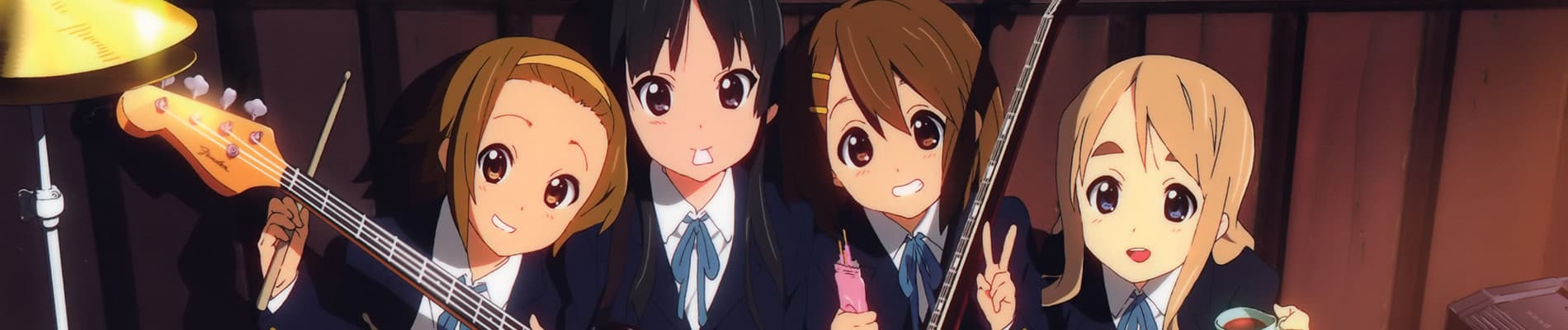
K-ON!
a review by GreenRevue
a review by GreenRevue
While some may understandably view K-ON as a show without much to it, this in my opinion is simply not true, well it kind of is in a way, but I find that's in part the point. Even in this first season, this point, the worth of the show, is incredibly clear in my opinion. K-ON is deservedly a classic, a fantastic anime.
The show is about these girls having fun. I think fun is pretty essential no? Moreover, this isn’t purely empty entertainment (which is still worthwhile for its escapism role in people’s lives, don't get me wrong), but as well as providing fun, it reminds us of the worth of fun, while many forget it as adults or take it for granted when younger. Not only do we have fun watching K-ON, but so do the characters, and in doing so, in living their adolescent lives in this club, they find a place to belong.
Mio and Asuza love music, and while it frustrates them at times that the band doesn’t commit as hard to practicing as they might, they ultimately love the light music club and the music they make. They love it, because it’s THEIR club, THEIR music. It’s music they make together, as friends. It shows the worth found in feeling found, the value of belonging somewhere and the comfort that provides. K-ON season 1 plays off quite slightly with it's point. There’s a reason the show consistently shows a tortoise and a hare motif, because the K-ON girls are taking life slow, and are winning for it. The show is full of passion, with a huge attention to detail, not just in the genius animation direction and character designs of HoriHori and KyoAni, and the overall aesthetic crafted by Yamada and team, but in the setting. Recurring visuals, plasters falling off a forehead during an emotional moment, and Easter eggs like changing scribblings on the club board.
Season 1 is often seen as weaker, and for good reason, with season 2 fully diving into the themes through the changes it brings to the table, but this first season is far from weak. In my opinion, the worth of watching these girls enjoy life is more than clear from season 1 alone. Yui is airheaded throughout the series, falling over at the start of episode 1, with her toast in her mouth, and getting distracted petting cats. However, by the end, still lovably airheaded (that is who she is, and she is loved for it, not just by us but by her club, she belongs), she does not fall over or get distracted, she has a place she belongs to run to, as the storyboards are masterfully repeated yet changed by Yamada in episode 12 to drive the point home. K-ON is a celebration of youth and belonging. While arguably “nothing happens", that nonchalant spending away of time is everything to the girls, and belonging somewhere is everything to people when it happens.
The scene from episode 12 I mentioned is shown below, of course spoilers for that episode.
Similarly some view the girls as cliché, I myself have done this before. However, I find that many view characters with distinct traits as cliché (I myself am definitely guilty of this in places), an upsetting trend of simplifying things that are distinct while revering things that are more hidden and characters with less clear personalities (of course great when done well). Real personalities brushed off as clichés. They wear their personalities on their sleeve, but their environment lets them do so. Their personalities are distinct, and arguably cliché, but the beauty of them is that oh so many have said how much they remind them of themselves or people they have known, the amount of life in them. Why are characters being distinct like this a flaw, if many find relatability and comfort from them? Simplicity in character is also arguably key to K-ON, complex backstories would be out of place in a show where people are purely happy and enjoying their lives, this is not what the show is for, occasionally dealing with issues, but getting over them together.
There are other shows that have warmth as well as dark themes, and are brilliant, such as March Comes in Like a Lion (same art director coincidentally, good at creating warmth), but K-ON should not be like those and is brilliant in its own way. The environment and atmosphere of K-ON allows its characters to thrive and for their traits to be fully expressed and at the surface. K-On commits to recurring jokes, ingraining them as genuine character traits as opposed to cheap gags. The show is like a warm hug that pushes you forward.

Episode 13 ‘Winter Days!’ shows this very well, brilliantly directed by Yamada. The characters go off doing their own things, to varying success, and it feels… different. They are still living their lives, Mugi doing well at her job, Ritsu having a relatable dealing with her appearance and relationships, Mio struggling to write music lyrics, relatable to anyone who has ever been passionate about anything, Yui sleeping (of course lol, also relatable), and Azu-nyan’s extremely relatable anxiety over dealing with her doppelganger. However, the strength of the episode shows when they get back together, and the energy quickly livens up and all which that means. These girls have their own lives, the show makes sure you know this, but their lives are most vibrant when together. “Fun” may not seem like a good theme on the surface, it may not be some complex philosophical work, but K-ON’s complex simplicity is a mantra for which to enjoy life, and that’s exceptionally important. Episode 4 (and many others) also drives this point home exceptionally well, with the fireworks display and Yui playing at the end of their training break.
▶ Video (this scene is so well animated and is a great encapsulation of Yui and a lot of the show).Also just want to quickly shout out the EDs, great music from HTT, and incredibly fun and stylish music video style visuals from Yamada.
▶ VideoK-ON is about girls eating cake, drinking tea, and sometimes playing music, and isn’t that how we should all aim to live our lives?
107 out of 111 users liked this review
