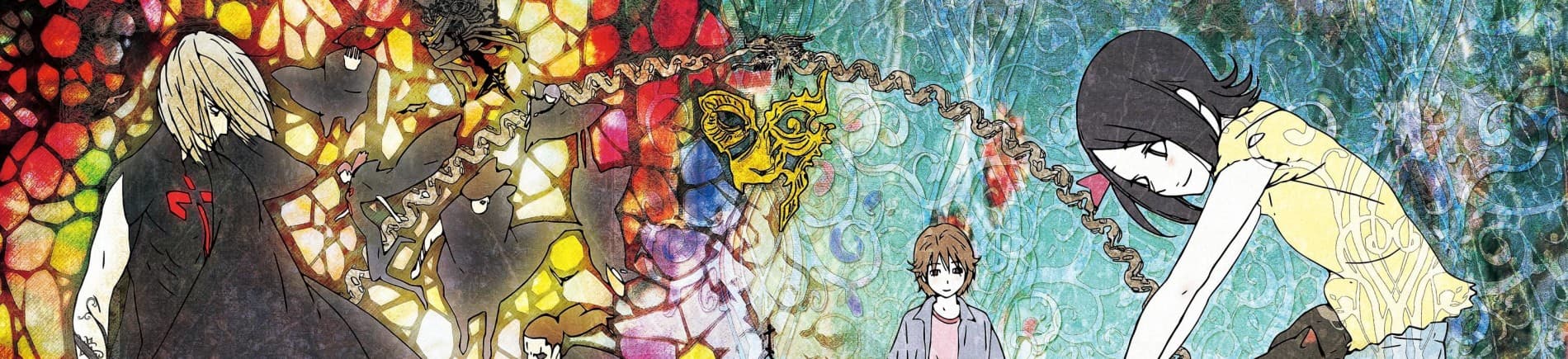

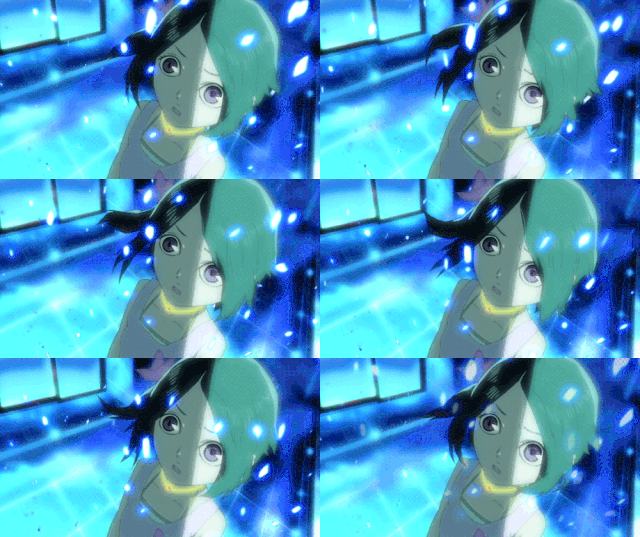
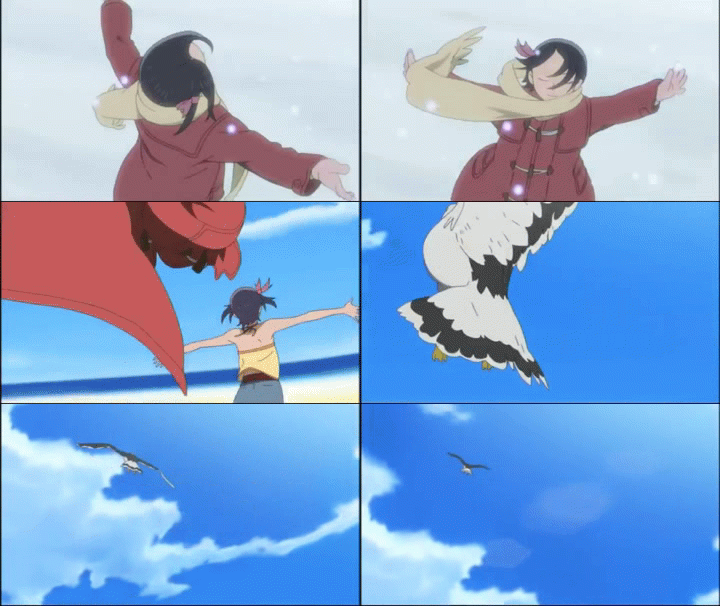
 Noein is ultimately a story about relationships and connections and empathy. Validating the existences and difficulties of others. Being there to help people, and allowing ourselves to be helped. It is about surviving the past, and hoping for the future. Noein is about a lot, be it its huge scope sci-fi narrative and quantum physics, or its many emotions and important themes to that effect. It's a grand show in both ways. A big show with a big heart.
Noein is a messy show for sure, but ultimately quite fantastic. I would definitely place it in the realms of Lain and Eva for its sci-fi existentialism, themes, and conclusions. Yet despite similarities it is very much its own thing, with copious amounts of genuine heart.
Firstly, to get the audiovisuals out of the way first, it is visually quite gorgeous despite some definite occasional inconsistencies. The CGI stands out but works, with the house model being the only main thing that occasionally feels weird. The creatures are all alien and scary and their difference through CGI works within the multiple world structure. Part of me mildly wonders if they influenced Land of the Lustrous, with similar shapes when cut too, but it's very unlikely.

Continuing on, the show’s general art direction aesthetic is quite nice, with a softness to it and hints of pastel that come with Akane’s works. Of course, this aesthetic changes wonderfully when necessary towards greater stylisation, with saturated reds and blues coming in a lot, and with other stark or striking colours or atmospheric busyness to the backgrounds coming in at times when effective.

Of course Kishida’s character designs are super unconventional but so personable and really good. I really like these very angular and interesting character designs. The designs lead to very expressive work in general, with some great poses and sharp animation work. The most notable thing about this though, despite the overall wonderful art direction, unconventionally great character designs, and good direction/ storyboards in general especially in key moments, is the animation.
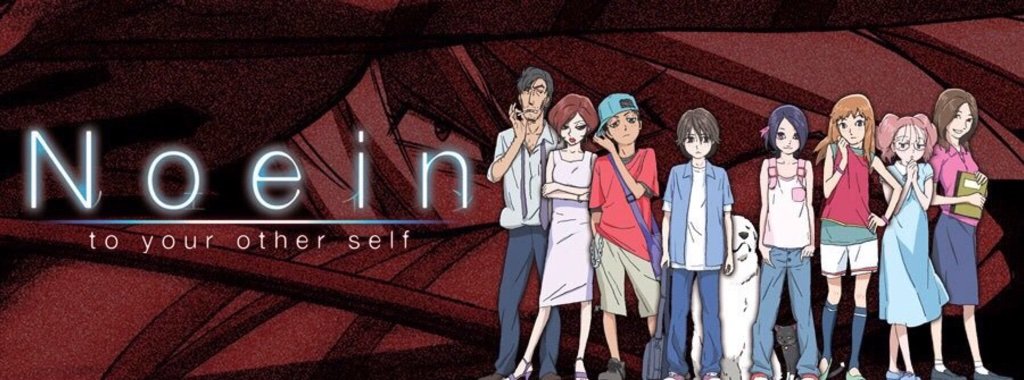
The animation is a really early example of artists at the forefront of digital animation, or maybe digital action animation is a better term, I’m unsure. Ryotimo and Norio Matsumoto pull off wonderful feats, which are even more consistently applied to Akane’s next directing work on Tetsuwan Birdy Decode (where Shingo Yamashita turns up and does wonderful work). Anyways, this is not about Birdy Decode! For example, the first episode and last episodes of Noein are wonderfully animated in very expressive and malleable ways, courtesy of not only Kishida’s designs and animation, but also other animators unafraid to abstract and move away from them, and Akane’s allowance of that. Episode 12 is perhaps one of the most impressive feats of animation I have seen especially in TV, as sketchy linework as well as elastic animation create superb action scenes from Ryotimo and others. Moreover, the overall episode just has great character acting such as from Norio Matsumoto or what may be his AD corrections. Perhaps my favourite action scene in anime in this episode. Wonderful stuff.
Mild spoiler:
Also talking about audiovisuals, I cannot miss the audio part. The sound design seems very effective at many points, such as in memories and dimensional movement and such. Moreover, the music by Masumi Itou can be wonderful be it lighthearted and catchy music for slice of life parts, or deep or powerful orchestral swells, some of which have chanting, and so on, for other parts.
NOW! Enough of the audiovisuals, lets get on to the exceptional plot and wonderful characterisation. Sadly this is all spoiler territory so will be marked as such.
Amongst all the grandiose (
Spoiler, click to viewclick to hide
quantum dynamics, past and present and future, different versions of people, infinite dimensions and possibilities, and so onSpoiler, click to viewclick to hide
One idea Noein posits is people observing your existence, of it being set by observation, it's on the surface quite literal (quantum dynamics, physical existence), but when taken with a twist of emotions and psychology (which the shows also does here and there) it is far more abstract emotionally on top of being physical. It is almost a lonely idea, yet it can also be comforting in context. This idea of Noein’s kind of reflects the feeling of loneliness quite fully through something as seemingly emotionless and unsentimental as quantum physics; that urge to be accepted for who you are is reflected, the importance of connection affirmed, the worth of carrying on and being empathetic and caring stressed.The future may not be pretty, things will be lost, there are infinite possibilities. Many are bad, many are not. Whatever the case, you cannot throw it away like Noein tried to, you must live with hope and live with grief if that hope does not come to fruition. Karasu's pain became instead a reminder of what was worth saving by contrast.
Importantly, we must keep acknowledging each other, caring for eachother, lest we cease to exist.
As much as anyone can live solitary, there is a need for others to acknowledge us. Being seen helps validate our existence in this social world.
Moreover, Atori represents these ideas and feels like a nice antithesis to the progression of Noein as a character, and also a comparison to the different Yuus. Atori is filled with hate, but loses his memories and instead becomes shaped by positive human connection. Even when his memories return, the connection remains, and his existence is validated, his hatred for the destruction and pain of the world shifted instead from wanting it all to disappear to wanting to protect others from it. Sometimes soft, but sometimes stern still once memories return, as he should be. Maybe both Atori's were observed, externally and internally, and thus both came to be.
By comparison Noein has forgotten human connection in his pain. As the show says he has forgotten Haruka. Surely that doesn't make sense? Yet it's perfectly true. He became so stuck in his pain and suffering he forgot what he actually truly lost, and the positivity that was possible beforehand. Noein became clouded in his thoughts. For one, Noein forgot what she would want, his happiness and that of others. Furthermore, and very importantly, there is goodness in the world even if it is sometimes lost. We must keep living.
For all the hell we may deal with, there are still an infinite number of possibilities, and our agency can steer us in one way or another. One world of nothingness is not a solution. Trying to merge all the possible emotions into one positive one, although seemingly good on the surface, merely removes all those other possibilities, all those lived experiences, with happiness and, yes, plenty of sadness. Many worlds that vary in pain are surely better than one sanitised one?
You (or Yuu in this case) can refuse to become a bad person like Noein, to fall into misery and hate. Thus Noein is no more, his existence gone. Not validating the existence of such a possibility means it isn’t one for you. You can at least try and shape your future, decide how you deal with it, no matter what fated pain there may be, no matter if Haruka does come to die in the world the show ends in. Agency is there. Yuu decides not to become Noein and to remember Haruka and what that remembering truly represents no matter what. Of course there are hellish futures people cannot help, “fates”, but others around them and in the rest of the world can at least try and live. We have to try.
In Shangri La, the world is a collective consciousness of sorts in Shangri La, or something similar. They noticed all these pains, and noticed suffering from miscommunication and such, and so they did this Eva-esque collective kind of thing. Yet even that group arguably refuses to let individuality be removed in the end, each dimension with their levels of suffering and happiness be merged into one personality devoid dimension of nothingness. They ask Noein to stop. Maybe they realised what they lost upon seeing the kids. Maybe they realised immediately upon creating their world. Maybe it's not simple.
Through its focus on empathy and other themes Noein explores the hope for a good future.
Spoiler, click to viewclick to hide
Don't fall into despair, keep fighting, and help your friends and family and other people to do the same. Haruka tells one future Isami to keep fighting to help Ai. Ai starts fighting to help Haruka when she comes to Lacryma. Yuu rejects Noein. Karasu and others reject their roles as knights. Haruka accepts her future in Lacryma for the sake of others and smiles. Haruka’s mother helps Yuu’s mother, and she becomes more empathetic and understanding (yet even then, the show is nuanced, Yuu is unsure what the future holds even when he regains freedom, as uncertainty is just how it goes for many). The bodyguard and scientist also help each other, and so on. In fact the bodyguard has undergone pain, and experienced horrible things, yet is still going and strong.Through its themes and narrative Noein also explores the pains of the past and living with them.
Spoiler, click to viewclick to hide
Haruka accepts the way her parents divorce turned out, the pain there for herself and for them, a past she cannot change, a world where it doesn’t happen cannot be created for her. Yuu’s mother is part of this idea too, all the characters are. It’s a mix between past experiences and future experiences, and the show interlinks them and gives a positive message of hope. Another example is an episode on memories fading, focusing on Haruka, which is quite impactful. Noein is an important show. It deals with the need to deal with the past, to go towards the future, to appreciate the connections and positives and slice of life moments you may have in the present (or had in the past, or will have, etc). Noein gets quite dark, especially towards the end, but it is hopeful and empathetic.Keep going, everyone, as best as you can. It’s hard to keep going through pain, it is, but please try, try to reach some happiness. We should all try to make the world a less painful place.