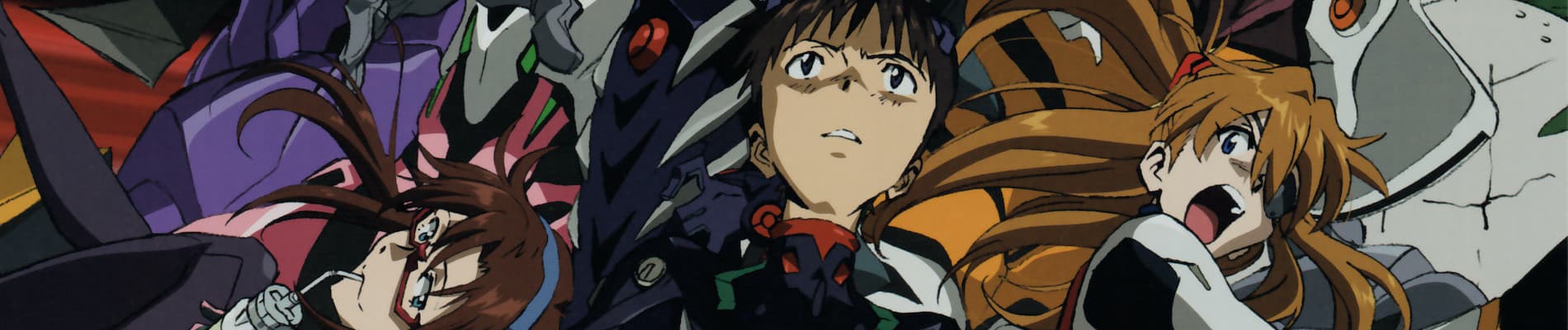


 We return once more to Evangelion's Rebuild movies, this time taking a look at the last movie for the foreseeable future, Evangelion: 3.0 You Can (Not) Redo, the third installment in the planned tetralogy. As I stated before, each passing Rebuild movie deviates more and more from the original television show. 1.0 was largely the first few episodes of Neon Genesis Evangelion with a fresh coat of paint and 2.0 recapped the next arc but deviated more and more until it stunningly concluded with completely new material. I predicted that in 3.0, we'd chart completely new territory as the Rebuild continuity completely divorced itself from the television show.
And I was correct! But being new is one thing, being good is another thing entirely. With this in mind, what do I think of You Can (Not) Redo? How exactly does 3.0 fare next to its predecessors, whether that mean the rebuilds or the television show?
Unfortunately, I find myself criticizing the new direction. As it turns out, what’s new is largely old, in some ways.
Evangelion: 3.0 You Can (Not) Redo follows directly where 2.0 left off, with the third impact averted and Rei and Shinji trapped inside Unit 01 via the Spear of Cassius that Kaworu threw. With all signs pointing to them being responsible for the decimation of Tokyo-3, UN raids the Geofront and the NERV staff is incarcerated. Most importantly, this movie marks the moment in which The Children of the Rebuild — Rei, Asuka, Shinji, Mari, and Kaworu — will finally come together.

Whoopsie, just kidding! In reality, Evangelion: 3.0 You Can (Not) Redo takes place a whopping fourteen years after 2.0. The Third Impact was just narrowly avoided but not before obliterating Japan and killing off most of the world’s already fledgling population. Shinji wakes up after being comatose to discover a battle-hardened Misato as the head of a new organization, WILLE. The movie follows Shinji as he tries to discover what has happened to the world and figure out if he can save it with his new, mysterious ally, Kaworu Nagisa.

The first thing viewers will notice about 3.0 (well, assuming they’re the type to stick around after the credits) is that it completely deviates from the preview established at the end of 2.0. The children are in the same location, I suppose (though the Rei we know and love isn’t there), but it’s not so much a meeting, it’s a fight, and their interactions with one another are pretty fledgling. While the Third Impact has technically been averted, it might as well not have been, because the world is still ravaged. We don't see the NERV staff being incarcerated. Really, the only thing from the preview that made it to the film is the fact that Asuka wears an eyepatch now. I'd encourage viewers to skip the preview, as it just makes the opening of the movie more confusing.
It can be pretty hard to parse out what's going on in the film. The timeskip from 2.0 to this one doesn't help in this regard as it takes a moment before we even realize we've gone fourteen years into the future. From a viewer standpoint, one moment everything is fine and everything has gone to crap in the next. It's fine for movies to have timeskips between installments, but there's usually context that makes the skip less jarring. Off the top of my head, I can think of three series that pulled it off a lot more gracefully. There's a five-year timeskip during the Avengers duology of Infinity War and Endgame. The latter picks up right after the first and has a timeskip after the movie has started, ensuring that viewers have the payoff to the previous plot threads while simultaneously making the timeskip obvious. There's a ten-year timeskip between episodes I and II of Star Wars, but time jumps between movies have been established at this point and the events of I had wrapped up sufficiently so that a timeskip wouldn't be jarring. Hell, the second Indiana Jones movie, Temple of Doom, takes place one year prior to the first, but it essentially doesn't matter, since the previous film wrapped up so nicely that viewers could easily jump into the next, establishing the episodic nature of these films. It might seem off-topic to talk about Hollywood films in an anime review, but it's to establish how 2.0 fumbled its handling of the timeskip and ultimately made for a more confusing experience than it needed to be. It's not only confusing, but its unsatisfying; 2.0 didn't wrap up nicely; the ending built a lot of momentum and plot-threads that were ultimately discarded due to the timeskip.

My bare synopsis gives you much more information than the movie itself gives viewers. As you can surmise, this makes for a disorienting experience. I'd urge for new viewers to read a brief synopsis going in, as it'll help a lot in getting acclimated to the new world. Many questions were buzzing in my head throughout the film and they really only began to be answered at the halfway mark of the film. Even then, the answers weren't really satisfactory and raised as many questions as they answered. I've heard the movie isn't newcomer friendly, but I think the point is moot, because I watched the original series and I still didn’t really know what happened. Since I have watched the original series, I knew it would be a good idea to check fan encyclopediae like EvaGeeks for answers. So, like the original series, you'll have to rely on supplementary materials if you hope to understand 3.0.
A counter-argument to my criticism could be that this is the point. Shinji has woken up after being in a sort of stasis for fourteen years. As such, he doesn't know what's going on, so it would only make sense that we, the viewers, similarly don't understand what's happening. I'll concede that this certainly makes sense, but unfortunately, I don't really care. While it's certainly artful that the structure of the movie emulates Shinji being a fish out of water, it doesn't make for a very pleasurable viewing experience. Annoyance being intentional doesn't change the fact that I'm annoyed.
In my review of 2.0, I stated "[the Rebuilds are] a new continuity, a seemingly more hopeful one. A continuity in which, even if characters must go through horrible trials to get there, there's a light at the end of the tunnel."

I greatly, disastrously misread the last movie, or at least what the movie meant moving forward. Evangelion: 3.0 You Can (Not) Redo vehemently spits in the face of any hopeful interpretation of 2.0's ending. For facing his fears and following his heart to save the girl he loved, Shinji is brutally, mercilessly punished. He's initiated Third Impact (somehow), resulting in him being the catalyst for the (newest) apocalypse. His worst fears are realized in that everyone hates him. He's robbed of his newfound purpose due to him being barred from piloting an Eva. Most damningly, the girl he loved has seemingly perished despite his efforts, making all the pain he's caused for naught. And that's only the beginning of the film; things get far, far worse at its end.

Unlike the hopeful, yet still tense movie I imagined, 3.0 is oppressively depressing and hopeless, with constant reminders that the world has been irrevocably damaged and Shinji's to blame. We watch Shinji descend further and further into madness and despondency. There's not much hope to be had, but there's just enough to get stamped out at the end, breaking Shinji (and the audience) further. There's a gloomy tone throughout, making it more tonally boring than 2.0 and more tonally off-putting than 1.0.
To be clear, there's nothing wrong with a bleak show; some of my favorite anime aren't the happiest. There is, however, something fundamentally undesirable about a show that basks in bleakness, because when everything's dark, nothing really is and you stop caring because it's all the same in its unpleasantness.

Honestly, my aversion could just be due to my own expectations. The ending of 2.0 did seem hopeful, it was sweet, but 3.0 retroactively made it this horrible choice of Shinji's all so that it could foster a depressing tone. It just feels so out of left field in light of what was built up. As an Evangelion veteran, this isn't exciting, we already got a depressing tone in the original. It actually reminds me of End of Evangelion in its unflinching, exhausting bleakness. A question I had after the movie was "what's the point?" What's Anno hoping to achieve with this reimagining if it ultimately comes out to be the same as the original? Oh sure, the setting might be different, but the takeaway seems like it'll be largely the same. Currently, it seems like it's hitting the same beats as the original, but worse.
Like in 1.0, the theme of the movie shines clearly. Towards the end of the movie, Shinji's goal is to reverse the damage he caused, "redoing" his time with the Evangelion. Kaworu even lulls Shinji into thinking redos are feasible. He states that, to get good at the piano, Shinji must keep playing a piece until he is satisfied with it. One look at the title shows that Shinji must learn that this lesson doesn't apply to life; no matter how hard one tries, they can't change the past, they cannot amend past mistakes, they must simply live with the horrible consequences. 3.0 also retroactively reveals the theme of 2.0. Namely that, no matter how hard you try, you can't advance in your relationships, you can't advance towards a brighter future; your efforts will only blow up in your face. You can even take these themes to a metatextual level. No matter how much fans may want it, Evangelion won't advance to become a happier series; there won't be a "redo" of the series in which everyone is happy in the end. Like Shinji with the events of the third impact, trying to "redo" Evangelion only results in a product that's as depressing as the original. Again, I'm left asking, "what's the point?" This sentiment could have been made by simply not making any more Evangelion-related works. Why spend millions of dollars to essentially flip off the audience? Burning money while angrily tweeting about the Evangelion fan base would have achieved the same effect with less hassle.

For what it's worth, the rebuilds are apparently supposed to be more hopeful than the original. It should also be noted, however, that production of 3.0 caused Anno to relapse back into depression. Make of this information what you will.
One thing I've heard is that the Rebuild series is happier due to the characters being less messed up. This sentiment only works in regard to the first two movies. It's true that in the rebuild continuity, Shinji is less cowardly and morose, Rei emotes more, Asuka is less of a gremlin, and Misato has more social moors and is less of a (possible) predator. These changes make it easier for some to empathize with the characters, but on the flipside, this makes it more heartbreaking when they suffer great misfortune.

Speaking of which, this go around, the characters were fine, I suppose. They didn't really grab me as much as before. Shinji acts in a manner you'd expect for a young man who just discovered that he caused the apocalypse while trying in vain to save his crush. While she goes back to being prickly, I still prefer this version of Asuka, who I like to call Pirate Asuka. Arrghsuka, if you will. Sure, she's an ass to Shinji, but it seems like she has a legitimate reason to be this time around, instead of being a general bully. Plus, I like the unique angle of her being a grizzled war veteran. I'm not sure it's fair to say that they reversed her character development from the last film; we see Asuka in a very different world than the last movie (another problem with the timeskip). However, that doesn't change the fact that, at least on the surface, it very much seems like the old Asuka.

Speaking of grizzled veterans, I was really interested in what they did with Misato. Gone is the bubbly, yet no-nonsense team mom, replaced with a stoic commander. Despite all of this, she still harbors affection toward Shinji as evidenced by the fact that she doesn't blow him up when she has the chance. It's a shame Misato is barely in the movie, though she certainly makes an impact in how starling her transformation is. Gendo is more the same, though somehow even a bigger jerk than he was in the television show.

I was sorely disappointed to see that Mari still has a bit part. Sure, she has a bigger role than in 2.0, but she’s still hardly in the movie. She's still a treat whenever she's on the screen though. This only makes me want more of her. At this point, I'm resigned to the fact that if I want to see more Mari, my best bet is buying figures of her.
Honestly, most of the characters saw little screen time. The only ones who were prominent were Shinji and Kaworu. Kaworu stole the show after having glorified cameos in the previous two movies. I love how he's so supportive of Shinji. Their chemistry was amazing and there was electric bishounen BL energy whenever they were on the screen. They even changed his design from previous movies to give him softer features. I'm half-surprised there wasn't a kiss.


But of course, this is 3.0 we're talking about. Kaworu tragically dies while stopping another impact, his blood splattering all over the Evangelion cabin next to Shinji, traumatizing the poor boy further as he's robbed of two people who unconditionally loved him. After two movies of teasing, it feels like such a waste to kill him after one movie. But I suppose they're just trying to emulate the show.

The action scenes were decent, though they felt more sporadic this time around. The pacing of this movie made it feel like not a lot happened when some pretty big things did unfold, plot-wise. I attribute this to the pacing and structure, which is mostly Shinji either moping or bonding with Kaworu. For what it's worth though, I did think Evangelion Unit 013, with its dual cockpit, was pretty awesome.

The art direction is still great and a standout scene is Shinji losing his grip on reality after finding out that he didn't save Rei. This makes for a very uncomfortable scene as Shinki walked in front of a shifting background with a wide-eyed, haunted expression on his face.
At first, I was going to say the music was worse, but upon listening to the OST again, I have to admit there are quite a few gems, some of which I added to the review. Unfortunately, 3.0 doesn't feature a rendition of Decisive Battle.

There are certainly things I liked about Evangengelion: 3.0 You Can (Not) Redo: the battles were pretty cool, Kaworu played off of Shinji nicely, and the setting itself was interesting. But these are overshadowed by my grievances including many characters' lack of screentime, the fumbling of the timeskip, and the dismal tone of the movie that departs from 2.0’s. After being so excited at the end of 2.0, I'm really disappointed in the direction Anno decided to take 3.0. 3.0 while being new, ends up taking too much of what I don’t like about the original series to fully enjoy it.
6.5/10
D
I've seen Neon Genesis Evangelion being likened to Star Wars in popularity, some going so far as calling it the Star Wars of anime. Taking this analogy a step further, we could say the Rebuilds would be the Sequel Trilogy of anime. The momentum built by 2.0 and The Last Jedi is squandered by The Rise of Skywalker and 3.0. In both series, I was prepared to like the sequel/reimagining more than the original, but the latest installment sullied my goodwill. The rebuilds, however, have something that the Sequel Trilogy doesn't. The rebuilds haven't concluded yet. The rebuilds could very well turn themselves around and leave a tetralogy that I enjoyed overall. For now, I remain cautious in my optimism.


105 out of 146 users liked this review
